#escapetheordinary
#iatraveler
#escapetheordinary
#iatraveler

My arrival in Shkodër technically began in Tirana, on a bus that functions nothing like a typical
intercity bus. There’s no ticket window, no digital kiosk, no official departure board. You simply
find the line of coaches and furgons, step onto one labeled Shkodër, and wait. When the seats
fill (every half hour or so) the door clicks shut and the bus eases into traffic as if the city itself
lifted it into motion. Schedules here aren’t printed; they’re lived.
About half an hour into the ride, the driver pulls over, stands up, strolls down the aisle, and
collects everyone’s fare (under 5 euro) with the casual confidence of someone who’s been
doing this forever. The whole exchange takes less than a minute. No fuss, no receipts, no
confusion.
What surprised me more than the process was how quickly the landscape opened up. Tirana
slipped away, replaced by fields, bright sky and the soft outline of the Lezhë mountains rising
around us like a gentle introduction to the north. Something in me loosened as we moved
through that wide stretch of land. Maybe it was the landscape, or possibly the quiet– the
contrast after the noise of the capital– but I felt a sense of ease settling in; I was drifting toward
something that had been waiting for me.
The bus dropped us at what can only be described as “an intersection where everyone seems
to magically know to get off.” There’s no official Shkodër bus station, just a busy crossroads
near the city center where furgons pause long enough for passengers to gather their bags and
orient themselves. Cars weave through, cyclists glide past, and the whole scene feels like being
placed directly into the bloodstream of the city.
My hostel was only a five-minute walk away, but after hauling a 70-liter backpack, a 30-liter
backpack, and a purse through Tirana, I didn’t feel like another CrossFit workout. A taxi cost
next to nothing, and for that price, I happily surrendered to four wheels.
Once I settled in and stepped back outside, I realized how close everything truly was. Shkodër
is one of those rare cities where walkability isn’t a feature– it’s the entire framework. Streets
connect in a way that makes sense in your body long before it makes sense on a map. Cafés
spill onto sidewalks. Produce stands brighten the corners. Stone lanes stretch into the old
neighborhoods like gentle invitations. The whole place hums at a pace that feels human,
unhurried, and strangely grounding.
Even crossing the street becomes part of the experience. Shkodër, with its population of
approximately 150,000, only has two traffic lights. Which seems absurd; until you watch how
everything works without them. People step into crosswalks with calm certainty that drivers will
stop, and the drivers just do. They rarely honk with impatience, yell or make rude gestures with
the competitive energy I often feel in bigger cities. The first time I crossed, I hesitated like
someone staring down a trust fall. By the third day, I found myself walking into oncoming traffic
with the same steady confidence as everyone else.
By early evening, Shkodër shifts. The heat softens, the light slips into that apricot-colored glow
that makes every building look gently sunburned, and suddenly the whole city seems to pour
into the streets. This is xhíro, the Albanian evening stroll; and If walkability is Shkodër’s
skeleton, the xhiro is its heartbeat.
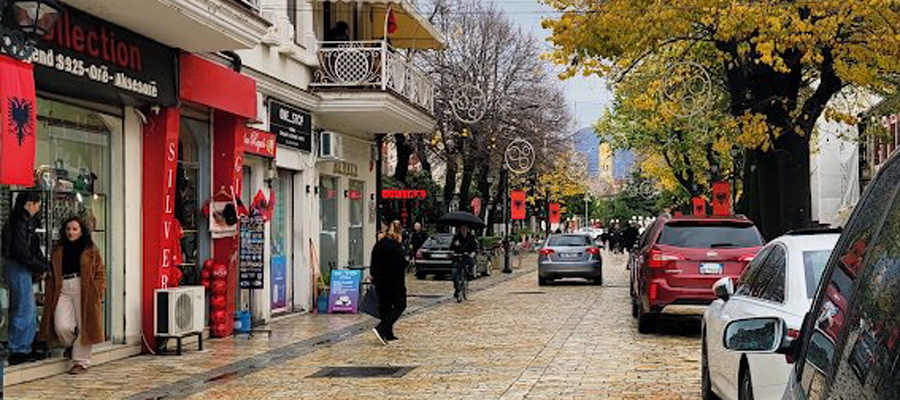
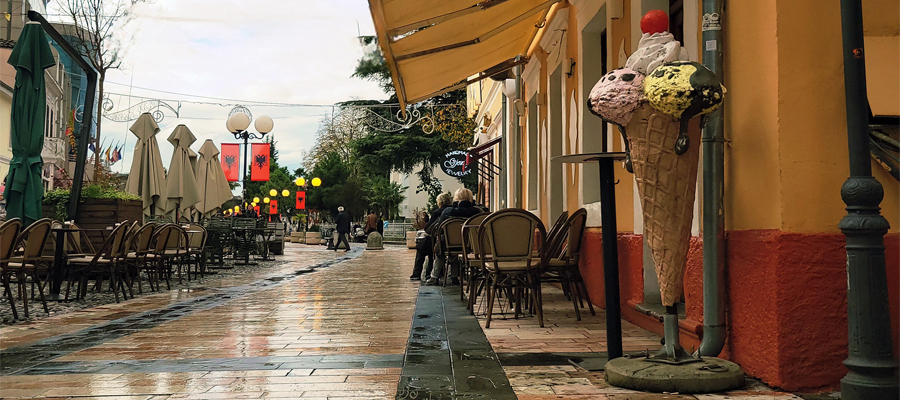
Every night, the main pedestrian street becomes a slow-moving river of people. Families drifting
in clusters. Grandparents guiding toddlers with unhurried steps. Teenagers orbiting each other
like shy satellites. Couples sharing intimate conversation. The smell of strong espresso mixes
with warm croissants and wood-fired byrek from the bakeries that stay open late, and someone
is always laughing somewhere.
Even if you come from a “walking city,” the xhiro feels different. It’s unhurried in a way Western
cities haven’t allowed themselves to be in decades. The pace is soft, ceremonial, yet somehow
incredibly social. If you’re a digital nomad in Albania (especially one who wrestles with work-life
balance) you start to understand why people move here and never leave. You can’t doomscroll
while strolling in a river of grandmothers in leopard-print coats and teens licking gelato; you are
forced to look up, notice, breathe, and move with everyone else.
Sometimes there’s live music drifting from the cafés; someone with a guitar covering a 90s hit,
or a speaker playing a song that everyone seems to recognize. Street vendors roll in with
roasted chestnuts or doners. The cobblestones click under bikes and strollers as the sky turns
indigo. The city feels impossibly safe, warm, and human-sized.
The best part is that the xhiro is free. It costs nothing to step outside, let the rhythm of the crowd
carry you, and be part of something that predates smartphones and Airbnb listings; something
that travelers searching for “Albania travel tips”, “things to do in Shkodër”, or “local culture in
Albania” would never fully understand unless they experience it.
As a traveler, you don’t have to speak Albanian to join in. You just step outside after dinner, pick
a direction, and walk. Eventually, you fall into the same easy pace as everyone else, and without
trying, you feel like you belong. That’s the thing about Shkodër: it surprises you by making room.
Of course, walking is only half the story here. Shkodër is also known as “the biking capital of
Albania”, and you see why almost immediately. There may only be two traffic lights, but I’m
convinced there are 200,000 bicycles;everyone here rides, and they do so with a fluid
confidence that feels both effortless and acrobatic. Women balancing groceries without losing
an orange. Teenagers doubled up on one seat, chatting as though gravity doesn’t apply to them.
Men pedaling with that cigarette-in-mouth ease that suggests they could do the entire route with
their eyes closed– because they probably have.
Meanwhile, I stand on the curb remembering the last time I felt personally victimized by urban
cycling (University of Montana, if you’re curious).thinking, “Not today.” I admire the cyclists from
a safe distance, like one admires professional dancers: with awe, respect, and zero intention of
joining them until sufficiently trained.
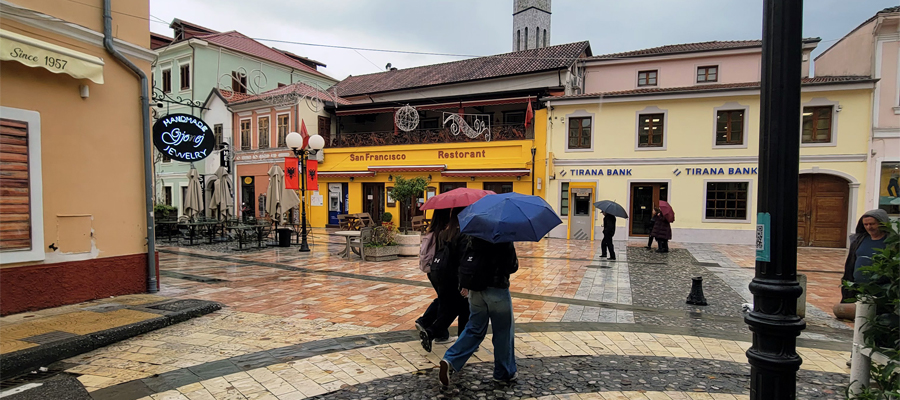
For now, I walk. It’s how I’m learning this safe, low-stress northern Albanian city– one corner at
a time. I pay attention to the echo of footsteps on stone, the warmth radiating off old buildings in
late afternoon, the clatter of coffee cups, the scent of bakeries, the way the light gathers on the
mountains at dusk. Shkodër reveals itself slowly, and walking is the best way to keep up with its
rhythm. Every evening, the city settles into that familiar pattern; the xhiro, the soft murmur of families
walking home, the hum of bikes gliding past, and I find myself falling into step with it.
Maybe one day I’ll use one of the bikes the Traveler Hostel has for its guests to borrow.
Or maybe I’ll keep discovering the city at walking pace, letting it unfold in the way Shkodër does
best: quietly, warmly, one lived moment at a time.
Post by: Sarah Joy